

Selling Peace of Mind
- 2025 saw five massive prices swings in ULSD futures
- Volatility is an opportunity for fuel marketers
- Backwardation creates several interesting sales ideas
- Natural gas trading sets several new records
Sincerely,
David Thompson, CMT
Executive Vice President
Powerhouse
(202) 333-5380
The Matrix
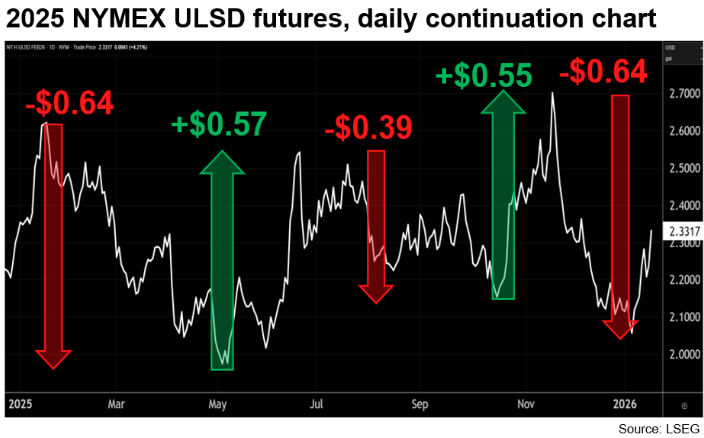
Looking at the chart above, it might be appropriate to offer fuel marketers congratulations simply for surviving 2025.
The geopolitical and economic factors that whipsawed the market last year have been well documented in The Weekly Energy Market Situation. While it’s important to understand what happened, your customers want to know what comes next.
While no one can consistently predict the future, all marketers can develop a consistent plan to deal with market uncertainty.
Front-month ULSD futures have rallied roughly $0.35/gal over the last two weeks. Backwardation has also increased substantially over that same time period. At writing, front-month ULSD futures are trading at roughly $2.42/gal. However, the futures strip covering the first half of 2026 (Jan-Jun) is trading at $2.28/gal. This is an opportunity for jobbers to offer clients a lower price and capture more volume.
To help end-user clients who are concerned that they’ve already missed the move, savvy marketers could present the idea of a price cap using call options. The $2.28 call strip covering the calendar months of January through June provides protection against prices above $2.28 while allowing for the fuel buyer’s costs to improve if prices decline.
The premium cost for those options is $0.14/gal.* This makes the customer’s break even $2.42/gal ($2.28 strike price + $0.14 option premium) – exactly where the front-month futures contract is currently trading.
Fuel marketers can use the current economic uncertainty as an opportunity to sell peace of mind. Please reach out if you’d like to discuss strategies like this in greater detail.
*Subject to change
Supply/Demand Balances
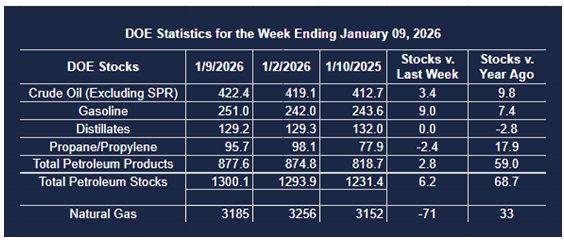
Supply/demand data in the United States for the week ending January 9, 2026 were released by the Energy Information Administration.
Total commercial stocks of petroleum increased (⬆) 6.2 million barrels to 1.3001 billion barrels during the week ending January 9, 2026.
Commercial crude oil supplies in the United States were higher (⬆) by 3.4 million barrels from the previous report week to 422.4 million barrels.
Crude oil inventory changes by PAD District:
PADD 1: Up (⬆) 0.2 million barrels to 7.1 million barrels
PADD 2: Up (⬆) 1.4 million barrels to 105.2 million barrels
PADD 3: Up (⬆) 2.2 million barrels to 237.8 million barrels
PADD 4: Up (⬆) 0.1 million barrels to 24.5 million barrels
PADD 5: Down (⬇) 0.4 million barrels to 46.5 million barrels
Cushing, Oklahoma, inventories inventories were up (⬆) 0.8 million barrels to 23.6 million barrels.
Domestic crude oil production decreased (⬇) 58,000 barrels per day from the previous report to 13.753 million barrels per day.
Crude oil imports averaged 7.092 million barrels per day, a daily increase (⬆) of 752,000 barrels. Exports increased (⬆) 43,000 barrels daily to 4.306 million barrels per day.
Refineries used 95.3 percent of capacity; an increase (⬆) of 0.6 percent from the previous report week.
Crude oil inputs to refineries increased (⬆) 49,000 barrels daily; there were 16.958 million barrels per day of crude oil run to facilities. Gross inputs, which include blending stocks, increased (⬆) 99,000 barrels daily to 17.300 million barrels daily.
Total petroleum product inventories increased (⬆) by 2.9 million barrels from the previous report week, up to 877.7 million barrels.
Total product demand increased (⬆) 1,783,000 barrels daily to 21.009 million barrels per day.
Gasoline stocks increased (⬆) 9.0 million barrels from the previous report week; total stocks are 251.0 million barrels.
Demand for gasoline increased (⬆) 134,000 barrels per day to 8.304 million barrels per day.
Distillate fuel oil stocks decreased (⬇) 0.1 million barrels from the previous report week; distillate stocks are at 129.2 million barrels. EIA reported national distillate demand at 4.096 million barrels per day during the report week, an increase (⬆) of 900,000 barrels daily.
Propane stocks fell (⬇) by 2.4 million barrels to 95.7 million barrels. The report estimated current demand at 1,317,000 barrels per day, a decrease (⬇) of 102,000 barrels daily from the previous report week.
Natural Gas
The massive price jump in NYMEX natural gas futures on Tuesday, 1/20/2026, broke some trading records according to the CME.
- A record 800,000 Henry Hub options traded on Jan 20th – highest single day ever
- Record volume in both monthly options and weekly options
- Over 620,000 options traded on-screen
- Record TTF Nat Gas options, 35,000 lots
- The second highest Natural Gas Futures volume at over 1.6M futures traded
Interesting to note, open interest in NYMEX NG futures has been declining modestly since January 9th. This suggest some portion of recent buyers have been short positions covering. With today’s (1/21) trading action, the front-month futures contract is now closing in on overbought levels on the RSI.
According to the EIA:
- Net withdrawals from storage totaled 71 Bcf for the week ending January 9, compared with the five-year (2021–25) average net withdrawals of 146 Bcf and last year’s net withdrawals of 227 Bcf during the same week. Working natural gas stocks totaled 3,185 Bcf, which is 106 Bcf (3%) more than the five-year average and 33 Bcf (1%) more than last year at this time.
- The average rate of withdrawals from storage is 8% higher than the five-year average so far in the withdrawal season (November through March). If the rate of withdrawals from storage matched the five-year average of 15.6 Bcf/d for the remainder of the withdrawal season, the total inventory would be 1,924 Bcf on March 31, which is 106 Bcf higher than the five-year average of 1,818 Bcf for that time of year.
Was this helpful? We’d like your feedback.
Please respond to All@powerhouseTL.com
This material has been prepared by a sales or trading employee or agent of Powerhouse Brokers, LLC and is, or is in the nature of, a solicitation. This material is not a research report prepared by Powerhouse Brokers, LLC. By accepting this communication, you agree that you are an experienced user of the futures markets, capable of making independent trading decisions, and agree that you are not, and will not, rely solely on this communication in making trading decisions.
DISTRIBUTION IN SOME JURISDICTIONS MAY BE PROHIBITED OR RESTRICTED BY LAW. PERSONS IN POSSESSION OF THIS COMMUNICATION INDIRECTLY SHOULD INFORM THEMSELVES ABOUT AND OBSERVE ANY SUCH PROHIBITION OR RESTRICTIONS. TO THE EXTENT THAT YOU HAVE RECEIVED THIS COMMUNICATION INDIRECTLY AND SOLICITATIONS ARE PROHIBITED IN YOUR JURISDICTION WITHOUT REGISTRATION, THE MARKET COMMENTARY IN THIS COMMUNICATION SHOULD NOT BE CONSIDERED A SOLICITATION.
The risk of loss in trading futures and/or options is substantial and each investor and/or trader must consider whether this is a suitable investment. Past performance, whether actual or indicated by simulated historical tests of strategies, is not indicative of future results. Trading advice is based on information taken from trades and statistical services and other sources that Powerhouse Brokers, LLC believes are reliable. We do not guarantee that such information is accurate or complete and it should not be relied upon as such. Trading advice reflects our good faith judgment at a specific time and is subject to change without notice. There is no guarantee that the advice we give will result in profitable trades.
Copyright 2026 Powerhouse Brokers, LLC, All rights reserved