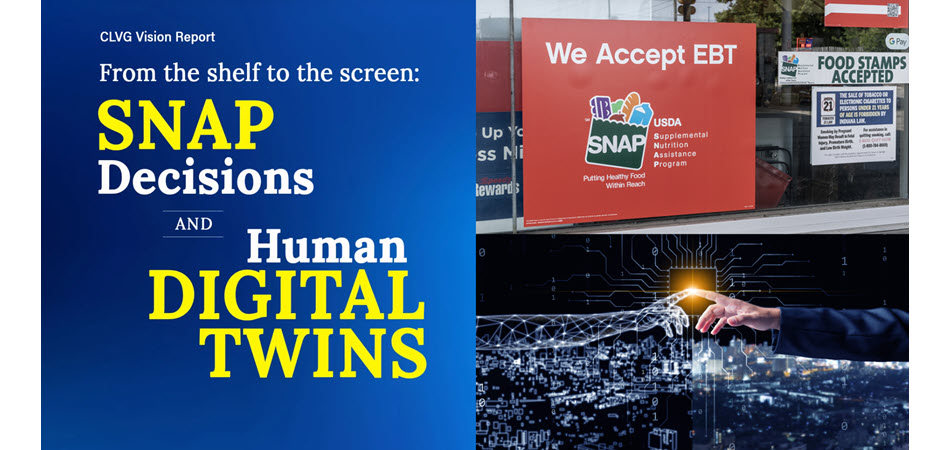
The Convenience Leaders Vision Group (CLVG) has released its latest Vision Report, “From the Shelf to the Screen: SNAP Decisions and Human Digital Twins,” in a brand new online digital format, examining regulatory changes to the federal SNAP program and the emerging technology of human digital twinning.
The CLVG virtual meeting, held on January 15, 2026, was facilitated by Roy Strasburger, CEO of StrasGlobal, president of Compliance Safe, and Vision Group Network (VGN) co-founder. The meeting featured presentations from Margaret Hardin Mannion, NACS director of government relations, who detailed the SNAP program changes and compliance challenges, and Brady Brim-DeForest, founder of Secundo, who introduced cognitive twin technology that enables digital models of individuals to act on their behalf.
Key takeaways in the report include:
- Oh, SNAP: Changes and Challenges Immediately Impacting Retailers: The SNAP program is undergoing unprecedented changes, with 18 states receiving approval to restrict products like soda, candy, and sugar-sweetened beverages, creating a patchwork of varying definitions and compliance requirements. “No two states are alike in how they’re defining the words candy or sugar, sweetened beverages, soft drinks, or soda. It’s all completely different,” said Margaret Hardin Mannion, director of government relations at NACS.
- Compliance Costs and Implementation Challenges: The convenience store industry faces an estimated $1 billion in upfront compliance costs, with last-minute, perplexing guidance released on December 31st, 2025. “I encourage everybody to go back to their business and look at their SNAP dollars, particularly if you do business in food desert areas or if you do business in urban areas that are far away from grocery stores, or in rural areas…It’s a pretty good chunk of business,” said Hal Adams, former managing director at Oxxo USA.
- Stocking Requirements Threaten Program Participation: Proposed requirements for seven varieties instead of three in four food groups could force thousands of convenience stores out of the SNAP program, threatening food access for low-income Americans who depend on the 118,317 convenience stores representing 45% of all SNAP retailers. “[The new SNAP guidelines are] going to force people to the big boxes [stores]…They are creating food deserts where there are not, where they don’t exist right now,” said Jonathan Polonsky, CEO at Plaid Pantry.
- Digital Twinning Technology: Digital twins are digital models of individuals that access their complete digital footprint – emails, social media, messaging, and desktop activity – coupled with autonomy and authority to act on their behalf, enabling people to essentially be in two or more places at the same time. “Being able to build a version of yourself today, which feels rudimentary compared to where we’ll be in 10 years, that has the ability to provide you with 24/7 horizontal scale that can act on your objectives and your plans in real time simultaneously across multiple channels is really, really breathtaking when you actually experience it,” said Brady Brim-DeForest, founder of Secundo.
- Real-World Implementation of Digital Twins: Secundo’s cognitive twin technology is currently pilot testing in real-time organizational environments at 80% of Fortune 10 companies, demonstrating the technology’s potential to transform how businesses operate. The technology also raises unresolved ethical questions about transparency and consent and whether people should always know when they’re interacting with a cognitive twin versus the actual person.
The Convenience Leaders Vision Group (CLVG) brings together convenience retail icons and trailblazers for quarterly virtual meetings. During these sessions, members identify trends, challenges and disruptions in retail as well as present possible solutions and opportunities. The group is committed to sharing its views and perspectives in order to advance the convenience retailing and mobility industry. CLVG operates under and is a part of the Vision Group Network, which gathers the collective knowledge and ideas of its members to create a legacy of sharing within the retail community.