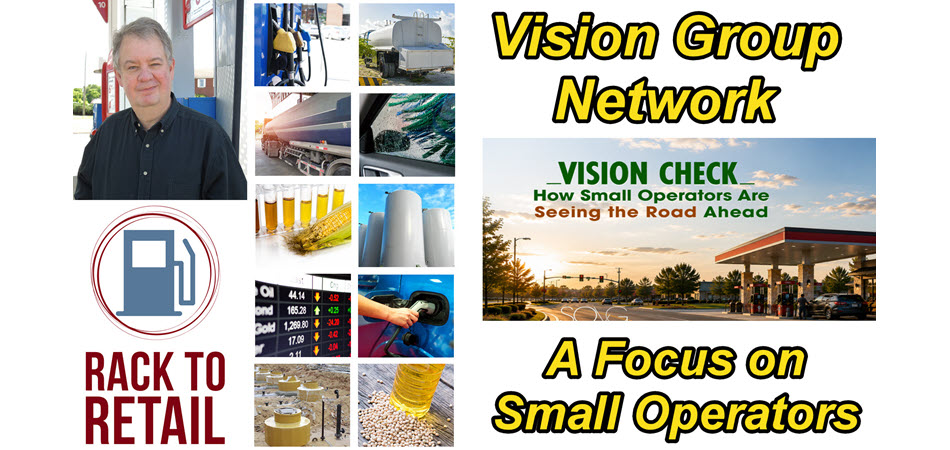
Roy Strasburger and Myra Kressner discuss the creation of the Vision Group Network (VGN) and its recent vision group focused on small operator needs (SOVG). VGN provides online meetings that are essentially share group events heavily focused on knowledge and networking, with individual vision groups covering specific subject areas such as electrification or food service. The second-half of the video contains the highlights from the inaugural SOVG meeting where they discuss issues ranging from the current impact of the economy on small operators as well as such issues as GLP 1 weight loss drugs and loyalty.
Watch on YouTube
Watch Without YouTube
Listen on Spotify
Transcript
Keith Reid: Today we’re going to be talking a little bit about the Vision Group Network and its latest meeting, which covered small operators. With me today are Roy Strasburger and Myra Kressner. A lot of folks in the audience probably know both of these individuals. They’ve been around the industry for a while and have an excellent reputation, and they’re the founders of the Vision Group. Roy, Myra, how are you doing today?
Roy Strasburger: Good.
Myra Kressner: Good, thanks for having us, Keith.
Reid: Well, thanks for being here. I’ve worked with Roy at Fuels Market News for years, and I’ve known Myra going back to the NPN days when she was at our competitor CSP, and I have a great deal of respect for both. Roy is one of the more knowledgeable individuals when you get into retail operations. So I suppose we can start with telling us a little bit more about yourselves, and then a little bit more about the Vision Group.
Kressner: Thanks. I’ll start off, Keith. As you mentioned, I’ve known you from your days at NPN and from my days at CSP, being in the industry for about forty years and really starting in the media world with CSP, which was sold in twenty twelve to Winsight and is now Informa. I’ve been very proud to be a part of the convenience and fuel marketing industry for those forty years. I started my consulting company, Kressner Strategy Group, about fifteen years ago. When the pandemic started in 2020, Kressner Strategy Group was working with Roy and Eva Strasburger and their company Stras Global. We found there was a need for communication during the pandemic, and that really was the catalyst for how the Vision Group Network started — as an experiment bringing very smart people together virtually every other month on Friday afternoons. We did that for a year and a half until coming out of the pandemic, and folks said, “This has been so valuable. You need to continue it and formalize it and create more Vision Groups.” That’s how the concept of the Vision Group Network started. I don’t want to take time away from Roy’s introduction, so we’ll go back to talk more about the Vision Group Network. But Roy, would you tell us a little bit about yourself?
Strasburger: Absolutely. And Keith, thanks again for having us today. It’s exciting to see your new program and everything taking off, so congratulations. My name is Roy Strasburger. I am the CEO of Stras Global, which is a retail consulting group, and also the president of Compliance Safe, which is a document management software program that retailers use to keep up with permits and licenses. I grew up in the retail business and have been actively involved in convenience and fuel retailing for about forty years. As Myra said, we had been working together right before the pandemic. Up to that time, my family owned and operated about one hundred fifty convenience stores in Texas. We were also involved in the management and supervision of about six thousand sites in thirty three countries. We’ve had a lot of experience in what makes retail work and what works in retail. What’s interesting is how different things are not just from country to country, but from region to region and city to city in the United States. One of the things about the Vision Group, which Myra, Eva, and I co‑founded, was the idea of sharing information so retailers can become better retailers. As we’ll talk more about today, and as Myra will explain with our different Vision Groups, we’ve been expanding to include as many parts of retailing as possible. One of the key things we do, following our motto of “sharing today to shape tomorrow,” is provide free vision reports to the public. I’ll let Myra talk more about how that came about.
Kressner: As Roy and I said in our introduction, the Vision Group Network developed organically. We found a need for regular communication, and we find that the virtual meetings and the groups our members commit to participating in are very effective. These are not one‑off webinars. Whether it’s our Convenience Leaders Vision Group, made up of C‑suite operators ranging from very large companies to small companies, these CEOs and COOs have said, “I want to be part of this group where I’m going to learn and share with continuity of engagement and networking.” The Convenience Leaders Group started in twenty twenty two. Shortly after that, we started a Convenience Technology Group with CIOs and CTOs looking at everything in technology from cybersecurity to integrating systems to AI. Then we started a Convenience Food Service Group because folks said, “We want to elevate food service in the convenience industry.” Again, it’s seeing the needs and bringing people together to exchange among themselves, and then, as Roy said, sharing that information through the digital vision report, which is available to everyone in the industry.
Kressner: We then started a Global Convenience Vision Group looking at EV charging. Keith, you can certainly speak to that. We said we needed to bring in the entire ecosystem of EV charging — convenience petroleum marketers, hospitality, municipalities, multi‑unit family housing. As we see the need, that’s how we develop new groups. Car wash is our newest product. And I think we’ll spend more time today talking about the Small Operators Vision Group, which has been discussed in many ways over the years. We define small operators as those with one to fifteen stores and said, “Let’s have a group dedicated to continuity and engagement with quarterly virtual meetings and shared insights.”
Kressner: We define our group as operators with one to fifteen stores and said, “Let’s have a group dedicated to continuity and engagement through quarterly virtual meetings and shared insights.”
Reid: You know, Myra, you raised something I was going to add. Small operators have always been a part of the audience when I’ve been on the fuel side at NPN and FMN. We’ve had some of the biggest oil companies on the list, but more than half of our audience has always been smaller mid‑size to smaller operators, down to single‑site operations. I remember years ago, I believe CSP might have been the first magazine to do it, and a few others jumped on.
Kressner: Right. The CSP Independent, and we also had a digital website for independents. The product was successful in sharing information as much as it could, but it didn’t have financial sustainability.
Reid: Yeah, I’m familiar with that. And that is interesting. I remember the transition before the majors got out of retail, when a lot of advertisers were only going after the oil companies. Once they got out of retail, the market opened up considerably down to the single‑site operator. You touched on this in some of the materials you put out about the rationale for launching this. Smaller operators really need the type of information and knowledge that can be provided by outside experts, even more than larger players. Everybody has challenges. There are plenty of challenges when you become a giant company and try to get things done. But with technology today, a smaller operator with the right model and focus can compete against larger players at a level they couldn’t before. It gets down to having access to insight, best practices, and the knowledge of their peers and others in the industry.
Strasburger: You’re right, Keith. One of the things we stress is that the word small in small operators means number of locations, not ambition or skill sets. The challenge for smaller operators is that they have to do everything right every time. Larger companies can solve problems by throwing money at them. Smaller operators don’t have those resources, so they have to be sure what they do is cost‑effective, efficient, and impactful. As you mentioned, over eighty percent of convenience and fuel sites in the United States are owned by what we call small operators. Their biggest challenge is having access to the resources, skills, and knowledge base that the big players have. That’s what we are trying to provide with the Small Operators Vision Group.
Strasburger: Every meeting, we put out a vision report with a recap of what we talked about. The vision report is free to download from our website at vgnsharing.com. What makes us unique in the world of conferences is that with most meetings, at best, you might get a copy of someone’s presentation. What we do is provide a recap of the meeting in the vision report. We also provide the actual presentation deck from the subject matter expert. We provide a video of their presentation so you can hear what they said about their deck. We make the transcript of the meeting available so people can see what was said. If you recognize an operator whose business is similar to yours, you can follow their comments and thoughts. All of this is made available for free, and it’s about helping a rising tide lift all boats so operators can become the best they can be.
Reid: I believe for this meeting, your subject matter expert was Dr. Tom Weandri? Is that how you pronounce it, or did I butcher that last name?
Strasburger: Let me make sure. Wynandi. You get to a point where you just say Tom. But yes, he is the principal research economist at Upside. Upside is a loyalty provider. They’re a network model, not an in‑house single‑site situation. They have data from about twenty three thousand convenience stores over twenty five months. We can start with some of the things he pointed out. With the current economic situation, high fuel prices, and general inflation, it’s been a mixed bag. There are more visits to retail sites because people aren’t filling up. They’re coming back getting five dollars here, ten dollars there. I’m dating myself when I say five dollars here, ten dollars there. Probably twenty dollars here, fifteen dollars there now. They’re going into the store more frequently, but total spend is down. Could you talk a little about that? He also brought up discrepancies between the traditional bread‑and‑butter blue‑collar male customer and more affluent customers.
Reid: Myra, would you like to start, or should Roy go?
Kressner: Why don’t you go ahead, Roy?
Strasburger: One of the things Dr. Tom talked about is that there are more transactions, but each transaction is a little smaller. For a smaller operator, that’s an important distinction. If you see more people coming through your doors, you might think your business is going up, but that’s not what’s happening. One of the key takeaways is that you’ve got to focus on transaction size and total gross profit dollars coming in, because that’s what drives your business. It’s not the number of sales, but the total gross profit dollars that determine how your business is growing.
Strasburger: One of the key takeaways is that you’ve got to focus on transaction size and total gross profit dollars coming in, because that’s what drives your business. It’s not the number of sales you make, but the total gross profit dollars that determine how your business is growing. Another point he mentioned, which you brought up, is that we’re in a K‑shaped economy. People in higher income brackets are doing relatively well and their spending is going up. Those in lower income ranges are managing their spending much more conservatively, and in many cases it’s going down, especially on the convenience store side.
Strasburger: One of our members said he has two stores. One is in a very affluent area, and one is in a lower demographic area. People in the affluent area are still buying, sales are going up, and things are going well. In the lower demographic area, sales have gone down. He can clearly see the difference in the K‑shaped economy. Myra, anything you want to add?
Kressner: To that point, many of these operators are family businesses. They know the folks who keep coming back, and they have conversations with them about pricing, affordability, and the challenges they face. There’s real engagement among their customers. They feel that relationship, and the staff feels it as well. A couple of operators made comments about that.
Reid: I think one of your retail members, Dennis McCartney, director of operations at Land Hope Farms, raised an interesting distinction. You had mentioned channel shifting earlier. He’s seeing customers shifting some of their purchasing to Walmart. It makes sense if every penny counts. I’ve certainly been there when every penny counted. But Roy, do you see any permanent shift out of this? When fuel prices drop and there’s more income available, convenience has a purpose, and it’s in the name of the industry. Convenience has value when prices come down. Do you see this having more legs, or will people shift their patterns back to the store again?
Strasburger: People are going to shift their patterns back. There will be a lag. When people start feeling better about the economy, it will take a little while for the shift to come back to convenience stores. What we sell in convenience stores is time. It’s fast in, fast out. We have items you know you want, and you know where they are and how to buy them. As the economy becomes more difficult, people make choices more carefully. Walmart and grocery stores become more of a shopping pattern because they offer lower prices and a wider range of products than a convenience store. They’re also getting their food, fresh fruit, and other items you don’t typically find in a convenience store, making it a one‑stop shopping opportunity.
Strasburger: When people feel more secure financially, convenience store sales will come back up because we are convenient. We’re on the way. As you stop to get gasoline or buy your morning coffee, you’ll buy something else. This is a temporary category shift, but it will lag behind people feeling better about the economy.
Reid: One interesting thing that caught me by surprise, not related to the economy, is that McKinley noted GLP‑1 drugs. For those unfamiliar, though it’s hard to imagine many are unfamiliar now, these are the weight loss drugs. He noted a shift in the in‑store basket. Consumers using these drugs are moving away from salty snacks and similar offers to protein and higher‑quality food offerings. That caught me by surprise, but it makes sense.
Kressner: That is true. He made that comment, and others have observed it as well. Roy, you may want to add to this, but two or three years ago our vision groups, and certainly Eva Strasburger, were catalysts in discovering the impact of GLP‑1s. Most people were not talking about it then. In our original vision group meetings, it was a subject, and we had serious discussion about it in a Convenience Leaders Group years ago. Some CEOs said, “I wasn’t focused on this,” and realized there was an impact on the convenience industry. Now it’s impacting all retail. It’s been a discussion for two or three years in almost every one of our vision groups. Some have been more aware than others, but now it’s front and center.
Strasburger: Some other applications of the GLP‑1 situation are that it’s not purely about category management and what products people buy. It affects existing categories. People don’t drink as much, so alcohol sales tend to go down. People are more selective about food. They go more protein‑heavy, and since they’re not eating as much, they’re selective about what they want. One big ramification in convenience is portion size, especially in food service. People want smaller meals. So is there an opportunity to market a reduced‑size plate at a lower price point but at the same gross profit dollars? That could attract people looking for specific meal options. It’s a wide‑ranging and huge impact on convenience and grocery.
Kressner: One retailer said the kinds of products they’re selling now actually have higher margins. There’s definitely a profitability story, whether it’s smaller portions at smaller prices or packaged products with higher margins and gross profit.
Strasburger: One last comment before we move on. These are lifetime drugs. If you stop taking a GLP‑1, there’s a ninety seven percent chance you’ll put the weight back on. People will be on these for extended periods. Eventually the price will come down so it’s affordable to more people. This is not a trend. This is a shift in consumer behavior. I think it’s a generational shift that will be around for decades.
Reid: The industry’s strong focus on food service over the last several decades has positioned it to move beyond offering the gas station burrito to offering the types of foods these folks want. It seems like a challenge already in the wheelhouse.
Strasburger: Food service has been considered the silver bullet to combat falling sales in tobacco, which GLP‑1 affects, and falling fuel sales. Everyone has been moving toward food service, and GLP‑1 directly affects that. It won’t eliminate food service programs, but you’ve got to be smarter with food service to appeal to a growing number of discerning consumers.
Reid: And real quick, Dr. Tom commented on loyalty, which is obviously in his wheelhouse at Upside. He noted that eighty six percent of shoppers said loyalty programs are important to them. Only thirty eight percent of convenience store shoppers and forty nine percent of fuel shoppers reported regularly using one. That may not be optimal for the operator or for Upside, but to me, that’s not a terrible result if you look at the history of loyalty adoption. There is room for improvement. If you’re using a program and you’re locked into it, you can get serious benefits, but there is room to grow.
Strasburger: One of the things that has come up in loyalty programs with the SOVG is how to have an effective loyalty program when you only have a limited number of stores. What is a cost‑effective way to approach that? One of the things we will be exploring in future SOVG meetings is right‑sizing loyalty programs for operators with fifteen or fewer sites. You can’t live by a punch card alone. You need more because your loyalty program is competing with other loyalty programs. How do you reward customers, and how do you get the most out of it without having a huge marketing department or analytical staff? That will be a big topic.
Kressner: Yes, all of our operators talked about that, and Verifone, our ally supporter member in the Small Operators Vision Group, will be exploring more about it as well.
Reid: Is there anything else that came up that you’d like to discuss before we close out?
Strasburger: I’ll make a couple of comments and then let Myra finish. This is probably stating the obvious, but smaller operators are their own niche, and they have their own niche problems. That is what we’re trying to address as the SOVG engages people from different regions. These are companies from one to fifteen stores across the country, each with their own challenges. Some common topics they want to talk about include how to deal with suppliers. The supplier community, especially broad line suppliers, are having a hard time meeting the needs of smaller operators. They feel like they miss out on trendy products and fads because by the time those products get to them after going through big chains, the trend has passed.
Strasburger: So how do they get products their customers want faster? Many are going to DSD vendors that operate door to door, and quite a few are going straight to manufacturers to try to get products in. But again, how do you do that with a purchase order large enough to keep a manufacturer engaged? Relationships will be a rich vein for us to explore with the SOVG.
Strasburger: Chris Banbury, one of our retail members, talked about regulation and how federal and state regulations on products he sells are difficult. A smaller retailer has more to lose if they get sideways with a regulatory issue. SNAP is a very important part of that. The new SNAP requirements are tough for a small operator to meet based on the type and variety of products they must carry. SNAP can be a large part of their client base, especially if they only have one or two stores.
Strasburger: Another thing we want to talk about is how these operators create personal relationships with their customers. As Myra mentioned, that goes beyond loyalty programs. It’s about being part of the community and being involved with organizations and neighborhood associations. There is a lot we can talk about. Myra may want to add more, but I’m excited about the SOVG.
Kressner: I don’t know that there’s much more to add other than that the SOVG members are very excited about being part of this vision group. They value having a platform to share information and learn from others. There is real excitement about being part of this and all the topics we’ve addressed, from loyalty to distribution to customer engagement to training. Every operator has to deal with these things, but small operators have unique needs. They find that being part of this group is a great way to share among themselves and take pride in being part of something bigger. We’re now sharing this information more broadly with the industry, and Vision Group Network is proud of that.
Strasburger: So Keith, my final comment is that if one of your listeners has subjects they want to talk about and are a small operator or consider themselves a small operator, they can contact you to share feedback. You’ll pass that on to us. They can also contact the Vision Group Network through vgnsharing.com. You can find our library of over seventy five vision reports on a wide range of subjects, free to download at vgnsharing.com. That is what we’re here for, to help provide more information and education. Thank you, Keith, for giving us the opportunity to get our message out.
Reid: Thanks to both of you. I’ll put links in the description so people can get there. Feel free to contact me through my website or through LinkedIn. Thank you very much. I look forward to seeing what’s happening with the Small Operators Group and the other groups you’re involved with. If you’re watching this on YouTube, please hit like and subscribe. It helps the channel. If you click the bell, you’ll be notified when new content is out. I also have newsletters that will notify you. Thank you very much. It’s been a pleasure.
Kressner: Thank you.