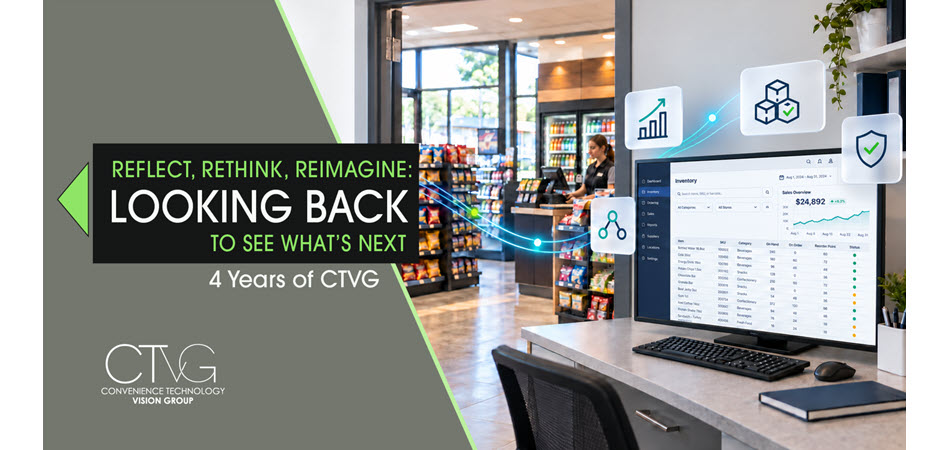
The Convenience Technology Vision Group (CTVG) has released its latest Vision Report, “Reflect, Rethink, Reimagine: Looking Back to See What’s Next – 4 Years of CTVG,” which looks back on four years of convenience technology discussions to examine what has changed, how AI moved from experiment to everyday tool, why integration remains difficult, how stores can become destinations, and why people and execution determine whether technology delivers real value.
The CTVG virtual quarterly meeting, held on September 18, 2026, was facilitated by Ed Collupy, principal of Collupy System Solutions LLC and CTVG advisor, who led members through the most impactful topics the group has explored since its founding in 2023. CTVG members and guests then reflected on what has changed, what hasn’t, and what retailers must improve over the next three years.
Key takeaways in the report include:
- AI Grew Up Fast: AI has moved from pilot programs to an everyday tool, with agentic AI now making it easier for retailers to pinpoint and solve specific problems in their stores. “Especially in this age of AI, he who can clean his data and prep it the best will get the greatest use out of AI tooling. And then he who can secure it the best gets to keep his job for the rest of the year,” said Steve Evans, chief technology officer for Haffner’s.
- Integration Is Still Hard: Every CTVG member surveyed in 2026 rated integration as a high priority or mission critical, yet none had achieved full integration, prompting retailers to take ownership of the integration layer and require vendors to provide APIs. One who applauds the standardization of APIs shared: “I don’t think we’re going to do business with a company that doesn’t use APIs moving forward,” said Rance Wells, vice president of IT at Toot’n Totum Food Stores.
- The Store Has to Become a Destination: With 72% of consumers now viewing convenience stores as a viable alternative to QSRs, but about half willing to abandon a site after just two bad experiences, retailers must give shoppers a reason to come inside, even at older locations that cannot be rebuilt and technology isn’t the only solution. Paul Kern, product leader at Invenco by GVR said: “You try to make the technology sort of blend into the background and just enable what the folks are doing. You don’t necessarily want it to be the sole focus of what’s happening.”
- Having the Technology Wasn’t Enough: Past discussions on retail media and cybersecurity showed that technology delivers value only when leadership, organizational alignment, and store-level adoption follow through. “I think historically we do a really good job of implementing technology, rolling it out and making a big deal about it, and talking about the importance [of it]. Along with that, I think what tends to happen is once we roll it out then we get back to a more comfortable place and maybe not driving as much focus on the utilization of that technology,” said Jeffrey Carpenter, director at Cliff’s Local Market.
- What Will Change and What We Have to Get Better At: Looking three years ahead, members said retailers must adapt faster, clean up their data, and protect the human connection that sets stores apart as technology looks more alike from chain to chain. “The biggest thing from maybe this time last year to now is I thought we were okay with data. And as we just continue down the AI journey and look at all the different systems and make sure that we’ve got clean data that we can point these things at that we need to get a lot better,” said Christopher Egan, chief information officer at United Dairy Farmers.
The online Vision Report format includes the must-read ‘CTVG Views’ summary, easily digestible Key Takeaways, and Notable and Quotable section.
To download this and other Vision Group Network Vision Reports, please CLICK HERE