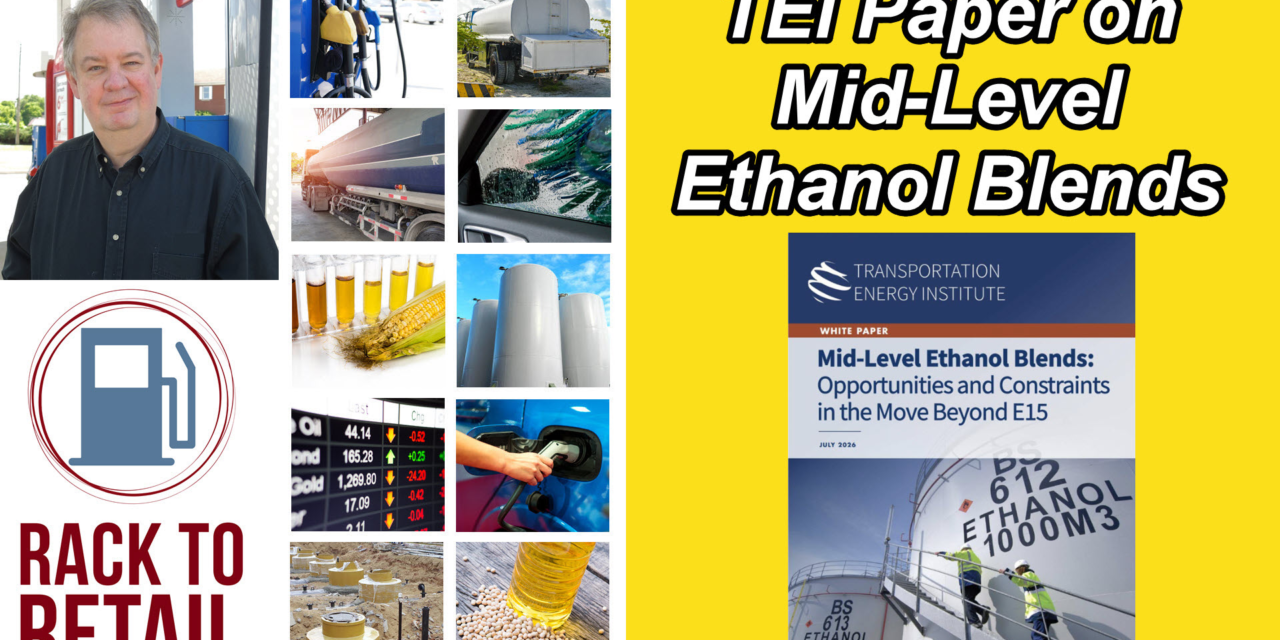
Mid-level ethanol blends above E15 (15%) and below E85 (85%) provide an opportunity to achieve carbon goals while still allowing for combustion technology and the traditional liquid fueling infrastructure. However, it is not a “drop in” solution. Notable issues would have to be overcome to bring this to pass. We discuss those opportunities and challenges with Transportation Energy Institute Executive Director John Eichberger. TEI has recently released a white paper Mid-Level Ethanol Blends: Opportunities and Constraints in the Move Beyond E15.
Transportation Energy Institute: https://www.transportationenergy.org/
Watch the Video on YouTube
Watch the Video Independently
Listen to the Audio Podcast on Spotify
Read the Transcript:
Keith Reid: Hi, I’m Keith Reid, owner and operator of Rack to Retail, where we provide content to fuels marketers and retailers in associated areas. Today we’re talking about mid‑level ethanol blends. I have John Eichberger, director of the Transportation Energy Institute. They’ve just released a new white paper on the subject.
It’s an area that’s been discussed at TEI over the years, but it’s time. It’s an ongoing process, and there’s no time like the present to explore potential solutions that offer advantages in the marketplace if they can come to fruition.
Reid: John, thanks for joining us.
John Eichberger: Thanks, Keith. Great to be here.
Reid: For those unfamiliar, tell us a little about TEI.
Eichberger: Transportation Energy Institute was founded about 13 years ago in 2013. Our goal is to bring different perspectives in the transportation energy market together to talk about what’s happening. We’re led by a board that includes major oil down to EV charging companies and everyone in between. We identify challenges and opportunities in the market, then provide fact‑based analysis to educate. We don’t advocate or pick winners. We want to provide knowledge so decision‑makers in business and government can make better informed decisions. If you know more, hopefully you can avoid mistakes we’ve made in the past.
Reid: And that point about not advocating is important. I’ve been to several meetings. I can’t cover them in detail as far as who said what, which is part of the purpose. Regulators and people in special interest areas can have honest discussions without worrying about it biting them later because they were too honest.
Eichberger: Exactly. Our papers are objective, peer‑reviewed, and fact‑based. When we get together in committees, working groups, or our annual meeting, the idea is to have a free open exchange of ideas. If anyone feels there could be a gotcha moment, they’ll hold back. By establishing Chatham House Rules, with no attribution or quotation without permission, people can speak openly. We’ve had people say things from the stage at our annual meeting that they would never say in public. It lets us have real dialogue about what’s honest and how we work together to find solutions that work for the market instead of trying to one‑up each other with talking points.
Reid: Absolutely. Now, mid‑level ethanol blends. Could you describe what would be considered a mid‑level ethanol blend?
Eichberger: It’s anything above E15 and under the flex‑fuel definition of E50. That middle ground: E20, E30, maybe E40. You see some of it at certain stations, typically in the Midwest. It’s been discussed for a long time. That middle section is market‑driven and regulatory‑approved, and it could present opportunities.
Reid: Certain sectors would benefit, so there’s a push. For consumers who want more aggressive carbon reduction, it offers a mechanism to drive traditional vehicles and get performance out of them. And by performance, I mean acceleration and other factors we both appreciate.
Eichberger: It’s a beautiful thing.
Reid: It is. Octane is important for high‑compression engines. Detroit’s solution for power with smaller, more efficient engines has been turbochargers, which require higher octane and premium. You don’t have to use premium, but you usually feel more comfortable using it even if it’s more expensive. Mid‑level blends would benefit that technology. But there are financial pressures, especially in the agricultural sector. We have E10 and E15 now. What pressures are coming into play for ethanol volumes as time passes?
Eichberger: It’s interesting. I started working on this paper more than a year ago. Timing worked out well. With the conflict in Iran, we’re looking at how to insulate our market from geopolitical volatility. First of all, we can’t. We have another paper on global energy flows to understand that better. We can’t absolve ourselves from geopolitical influence. But there’s interest in boosting domestic resources and domestic renewable resources. Carbon is on vacation with this administration, but globally it’s still a priority. Domestic energy security is critical. We’ve seen new investment. New RFS numbers came out. There’s renewed investment in biomass‑based diesel and some infrastructure.
I looked at current market conditions. Assume we’re at 15 billion gallons of ethanol. We’re slightly lower, but assume 15. If fuel economy continues improving and demand doesn’t grow aggressively, we’ll need close to a 20 percent blend level in the next 20 to 25 years to maintain 15 billion gallons. Cars are getting better, demand is projected to go down. To sustain the ethanol market, we need higher blend rates.
We’re seeing growth in E15. Congress is working on year‑round approval. Ninety‑five percent of vehicles are approved by EPA. Most are approved by manufacturers. California is close to opening E15. Huge opportunity. But even E15 won’t get us to 15 billion gallons.
So the combination of domestic energy security, carbon reduction, and sustaining the agricultural market led us to look at where we are. We’ve skirted around this topic for years. We wanted to put meat on the bones and ask: if this is the direction we might be going, how do we get there? I’ve been in this industry 25 years. I always ask: I know where you want to go. Do you know your hurdles?
Continued on the next page